The Part of Orthodontic Treatment We Don’t See in the Mirror
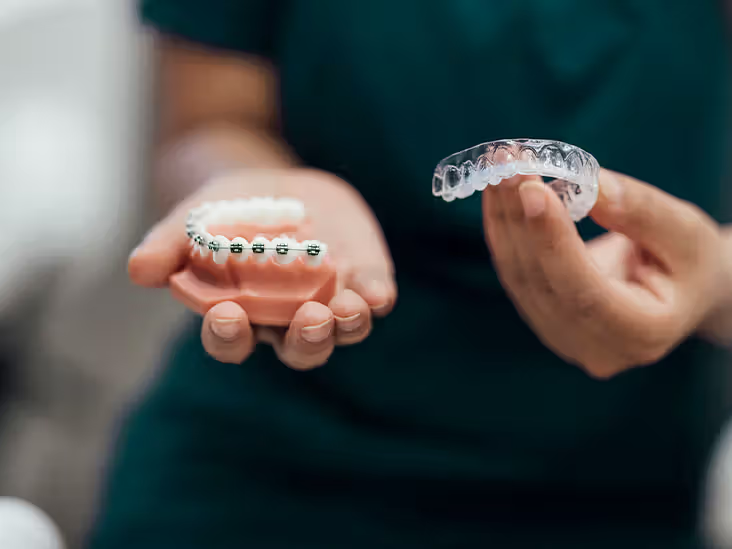
If you’re looking for an orthodontist, there’s a good chance you’ve already started comparing treatments. Invisalign here. Braces there. Clear brackets. Before-and-after photographs everywhere.
It’s very easy to choose the treatment before you’ve properly considered the problem. That is probably the wrong way round. Before deciding how we want our teeth straightened, someone needs to work out what actually needs changing.
Your smile may not tell the whole story
A crooked tooth isn’t always the whole problem
We might look in the mirror and see one tooth sitting out of line. An orthodontist may be looking at the way your upper and lower teeth meet, how much space there is, where the other teeth are positioned and whether there is a wider bite issue.
That matters because two people can have smiles that look quite similar and still need completely different approaches. The visible problem is only the starting point.
That’s why the consultation comes first
It can be tempting to walk into a practice saying, “I want Invisalign.” There’s nothing wrong with having a preference. But a good treatment discussion should go a little further.
What is causing the crowding?
Is there a bite issue?
Would clear aligners be suitable?
Would fixed braces give a more appropriate result?
Is there another option worth considering?
Those questions are much more useful than simply asking which treatment is most popular.
What does an orthodontist actually look at?
Assessment tells us more than a mirror can
A proper orthodontic assessment looks at the teeth and their position rather than relying on appearance alone. Depending on the case, photographs, X-rays or scans may also be used to help plan treatment.
Love-Teeth’s orthodontic service covers several teeth-straightening options, including Invisalign, clear aesthetic fixed braces and the Inman Aligner for certain cases involving front-tooth crowding. The practice says consultations include a treatment plan and quotation covering the available options.
That’s useful because it puts the decision back where it belongs: on the individual’s teeth rather than the popularity of a particular product.
Clear aligners aren’t automatically the answer
There’s an obvious appeal to clear aligners. If you’re an adult who doesn’t fancy wearing visible metal braces, a discreet option can sound ideal. But discreet isn’t the same as suitable. Fixed braces still have a role, and the right choice depends on what needs to be corrected.
So if you’re comparing an orthodontist in Greater Manchester, don’t just ask, “Do you offer Invisalign?” Ask why a particular treatment has been recommended.
A patient’s starting point can change the treatment choice
A patient story is a useful example
Love-Teeth Dental Practice’s reviews include a patient story, who had been unhappy about crooked and discoloured teeth and felt self-conscious about smiling in photographs and at work.
Her treatment involved tooth-coloured fixed ceramic braces. The practice says the braces worked well and that she was left with a straighter, more confident smile. That story is useful for one reason: the answer wasn’t simply “choose the least noticeable treatment”.
Her starting point and what she wanted to change shaped the treatment choice. That’s a much more realistic way to think about orthodontics.
The treatment doesn’t finish when the teeth look straight
Retention is the part people forget
Here’s something easy to overlook when you’re looking at before-and-after photographs. Straight teeth need to be kept in their new positions.
Love-Teeth describes retention as the most important part of orthodontic treatment and says its specialist team uses techniques designed to maintain alignment. That makes retention a useful question to ask before treatment begins, not something to think about after the braces come off.
Ask about the whole plan, not just the appliance
If you’re choosing an orthodontist in Greater Manchester, ask:
- What exactly needs correcting?
- Is my bite part of the problem?
- Which treatment options are suitable?
- Why is one option being recommended over another?
- What will treatment involve day to day?
- What happens once my teeth are straight?
Those questions give us a much better idea of what we’re signing up for than a quick look at a treatment price. The visible part of orthodontics is easy to understand. We can see the braces or aligners. We can see the finished smile.
The assessment and planning that came before them are much less obvious. They may also be the part that determines whether we chose the right treatment in the first place.